
At Wattzo, we develop site-specific energy forecasting pipelines grounded in sub-hourly metered data, generation, consumption, and grid exchange at the asset level.
We have been closely tracking the rapid advances in data-driven numerical weather prediction. The past two years have seen a step change in forecast skill from models such as GraphCast, Pangu-Weather, and now WeatherNext3, with benchmarks consistently showing these AI-based models matching or outperforming operational physics-based NWP systems at a fraction of the computational cost. This is not incremental progress; it represents a structural shift in how atmospheric state can be estimated at high spatial and temporal resolution.
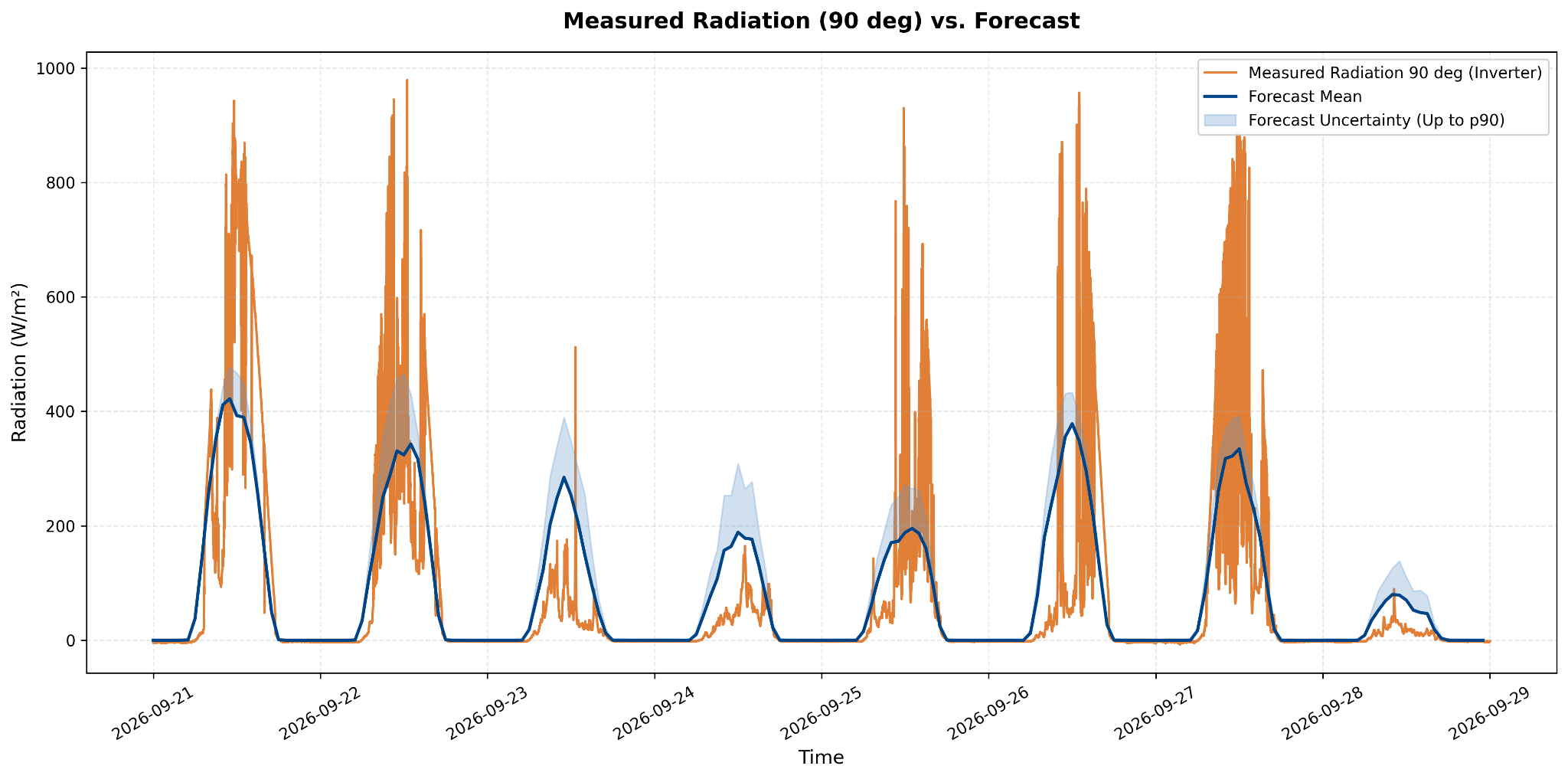
As part of our ongoing model evaluation, we assessed Google's WeatherNext3, an experimental ensemble forecast system operating at 0.1° resolution with probabilistic outputs, against ground-truth irradiance measurements from a photovoltaic inverter in Arvika, Sweden. WeatherNext3 had no exposure to observed data from this region during training, making this a true out-of-distribution test of its generalisation capability.
At Wattzo, data quality is a first-order concern. We maintain automated validation pipelines and anomaly detection across our metered data streams, because a forecast evaluation is only as meaningful as the ground truth it is measured against.
The good news
The forecast captures the daily cycle reliably. It knows when the sun rises and sets, and on overcast days it broadly tracks the suppressed radiation levels. The uncertainty bands widen appropriately when conditions are more variable: the model knows what it doesn't know.
The clear-sky problem
On the sunniest days, the forecast consistently underestimates peak radiation by roughly half. For an energy manager, this translates directly into missed opportunity: storage charged too conservatively, or backup capacity dispatched when it wasn't needed. These are not edge cases; they happen on the best production days of the year, when the financial stakes are highest. Wattzo quantifies exactly this gap: the cost of a wrong forecast at peak hour, expressed in operational terms a CFO can act on.
Cloud events: detected but underestimated
When clouds suppressed radiation sharply, the forecast caught the direction but not the depth. The practical consequence is an over-commitment to expected production: a solar asset manager who trusted the forecast would have planned for output that never materialised. At scale, across a portfolio of sites, that shortfall compounds into real imbalance costs and penalty exposure. Wattzo's decision layer sits above the raw forecast, translating uncertainty into a risk-adjusted operating envelope so that decisions are made with the right level of caution, not the forecast's level of confidence.
What this means
WeatherNext3 shows real promise as a foundation for solar forecasting in Scandinavia. As an experimental system, it performs well on cloud detection and captures the broad shape of the generation curve. Where it needs support is at peak hours under clear skies, where a systematic underestimation of around 47% can translate into consequential dispatch decisions.
If you work with solar assets in the Nordics and want to see how this applies to your site, reach out or request a demo at wattzo.org.